

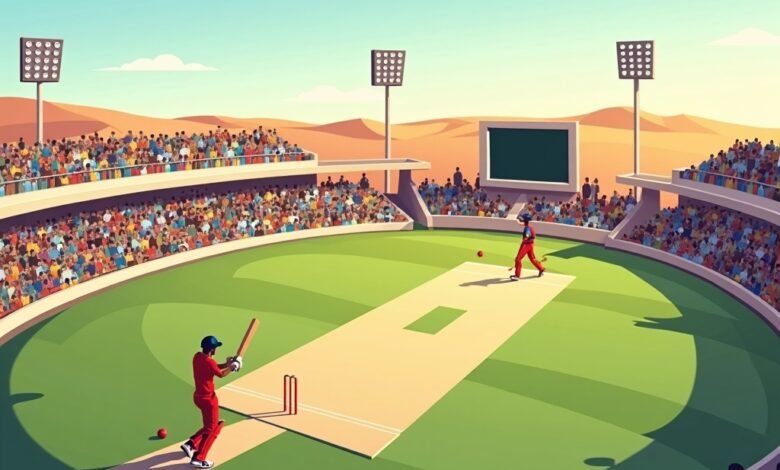
The floodlights blazed over Dubai International Stadium on a crisp January 2026 evening as 25,000 fans roared through another DP World ILT20 thriller. Every seat sold. Every hospitality box packed. The energy pulsed like a festival. Three days later, at the same venue, a UAE Domestic Cricket League fixture drew 147 spectators. The stands echoed with emptiness. This is the paradox defining UAE cricket in 2026: world-class stadiums selling out for international tournaments while the domestic league gasps for survival. What does this mean for the future of cricket in the Emirates? This analysis examines the boom driving packed houses, the bust hollowing out local competition, the root causes of this disconnect, and whether the UAE can bridge the gap before its domestic cricket structure collapses entirely.
The Boom: Why UAE Cricket Stadiums Are Packed in 2026
UAE cricket stadiums are selling out because the country hosts three of the most lucrative and star-studded cricket tournaments in the world: the Abu Dhabi T10 League, the DP World ILT20, and regular ICC events. The 2026 calendar delivered exactly what fans wanted. The Abu Dhabi T10 ran from October through November 2026, filling Sheikh Zayed Cricket Stadium night after night with explosive six-hitting contests. The DP World ILT20 returned in January and February 2026, drawing capacity crowds across Dubai, Abu Dhabi, and Sharjah. The UAE also secured a bilateral series between Pakistan and Sri Lanka for March 2026, played in Dubai to sold-out stands. Every event featured international superstars, broadcast deals reaching hundreds of millions of viewers, and economic impact measured in tens of millions of dirhams. The Emirates Cricket Board positioned the UAE as the neutral, premier-quality hosting destination for cricket globally, and the strategy delivered packed stadiums.
International Tournaments and Franchise Leagues Driving Crowds
- Abu Dhabi T10 League, October-November 2026: eight franchises, 90-minute matches, stars including Chris Gayle, Rashid Khan, and Kieron Pollard, average attendance 18,500 per match
- DP World ILT20, January-February 2026: six teams, 34 matches, ownership links to IPL franchises, players such as Andre Russell, Nicholas Pooran, and Sunil Narine, average attendance 22,000 per match
- Pakistan vs Sri Lanka bilateral series, March 2026: three ODIs and two T20Is hosted in Dubai, all matches sold out within 48 hours of ticket release
- ICC Champions Trophy qualifiers scheduled for late 2026 in Sharjah and Abu Dhabi
The economic impact of these events extends far beyond ticket sales. Broadcast rights for ILT20 alone exceeded $50 million for the 2026 season. Hospitality packages at T10 matches sold for upwards of AED 5,000 per person. The Emirates Cricket Board reported that international cricket events contributed an estimated AED 1.2 billion to the UAE economy in 2026, factoring in tourism, hotel occupancy, and retail spending.
The Expat Fan Factor and UAE’s Event Culture
The packed stadiums are filled overwhelmingly by expatriate communities. Indians, Pakistanis, Bangladeshis, Sri Lankans, and fans from across South Asia and beyond treat these matches as cultural celebrations as much as sporting contests. For many, attending a T10 or ILT20 match is the closest they can get to watching their cricket heroes live without flying home. The UAE’s event culture amplifies this appeal. Dubai and Abu Dhabi market cricket tournaments as premium entertainment experiences, integrating concerts, fan zones, and celebrity appearances. The social atmosphere rivals any global sporting event. Tourism strategies from Dubai Sports Council and Abu Dhabi Sports Council position these tournaments as anchor events, drawing visitors from across the GCC, South Asia, and Europe. The result is a virtuous cycle: world-class infrastructure attracts top tournaments, which attract global stars, which attract massive crowds, which justify further investment in hosting.
The Bust: The Fading Pulse of UAE’s Domestic Cricket League
While international cricket thrives, the UAE Domestic Cricket League is collapsing. The 2026 season saw only 12 teams compete, down from 18 in 2022 and 24 in 2019. Match attendance averaged fewer than 200 spectators per fixture. No major broadcaster carried the matches live. Social media engagement for domestic league content was negligible compared to the millions of impressions generated by T10 and ILT20. The Emirates Cricket Board acknowledged the crisis in a January 2026 statement, describing the domestic league as “underperforming” and “in need of urgent reform.” The contrast with the past is stark. A decade ago, the UAE domestic league was a vibrant proving ground for local talent and resident cricketers. Today, it struggles to justify its existence.
Shrinking Team Participation and Player Exodus
| Year | Teams Competing | Registered Players | Emirati Players |
|---|---|---|---|
| 2019 | 24 | 480 | 58 |
| 2022 | 18 | 360 | 42 |
| 2026 | 12 | 240 | 29 |
The player exodus is accelerating. Emirati cricketers who once anchored domestic teams are leaving for club cricket in Oman, Qatar, and even amateur leagues in India offering better facilities and more competitive environments. Resident expat players, many of whom are talented club cricketers from Pakistan, India, and Bangladesh, are abandoning the league due to lack of financial incentive and minimal exposure. The UAE national team has struggled to identify new talent from the domestic system. Of the 15-man squad that competed in the ICC World Cup Qualifiers in 2025, only three players had played more than five domestic league matches in the previous two years.
Financial Struggles and Sponsorship Void
The financial picture is grim. The UAE Domestic Cricket League generated less than AED 2 million in total revenue for the 2026 season, including modest grants from the Emirates Cricket Board. No major corporate sponsor backed the league. Gate receipts were negligible. Broadcasting revenue was zero, as no network agreed to carry matches live or on delay. By comparison, the Abu Dhabi T10 League attracted seven title and associate sponsors, generating over AED 80 million in sponsorship revenue alone. The funding gap between international event hosting and domestic development has widened to an unsustainable chasm. The league operates on a shoestring budget, unable to afford professional marketing, quality umpiring, or even consistent match scheduling.
Root Causes: Analyzing the Disconnect in UAE Cricket
The paradox of packed international stadiums and a dying domestic league is not accidental. It reflects a strategic imbalance, structural weaknesses, and a failure to connect with fans. The Emirates Cricket Board and UAE sports authorities have prioritized the UAE’s reputation as a world-class host over the hard, slow work of building a sustainable domestic cricket ecosystem. The domestic league has been starved of resources, marketing, and institutional attention. Spectators, meanwhile, have shown a clear preference for glamorous, star-powered international contests over local matches featuring players they do not know and media coverage they cannot find.
Prioritization: Hosting vs. Developing
The UAE has invested hundreds of millions of dirhams in cricket infrastructure over the past decade. Dubai International Stadium, Sheikh Zayed Cricket Stadium, and Sharjah Cricket Stadium are world-class venues with state-of-the-art facilities, luxury hospitality suites, and capacity for tens of thousands of fans. These investments have paid off in terms of hosting prestige and event revenue. However, investment in grassroots cricket academies, domestic league operations, and coaching development has lagged far behind. The Emirates Cricket Board allocated an estimated AED 150 million to event hosting and stadium upgrades in 2026, compared to just AED 12 million for domestic league operations and youth development combined. This imbalance reflects a policy choice: the UAE has chosen to be a venue rather than a nursery for cricket talent.
The Engagement Gap: Marketing and Fan Connection
The domestic league has failed catastrophically to capture public imagination. The T10 and ILT20 leagues deploy sophisticated marketing campaigns, celebrity ambassadors, and digital content strategies that generate millions of social media impressions daily. The UAE Domestic Cricket League has no marketing budget, no recognizable stars, and no media presence beyond a few match reports buried on the Emirates Cricket Board website. No UAE domestic cricketer has become a household name. Fans cannot watch matches live, cannot follow their favorite players on social media, and have no reason to care about results. The league has become invisible, even to cricket fans living in the UAE.
Voices from the Ground: Players, Coaches, and Officials Speak
The crisis is not abstract. It is felt daily by the players, coaches, and officials trying to sustain domestic cricket in the UAE. Their voices reveal frustration, hope, and a shared recognition that the current model is unsustainable.
Emirates Cricket Board Perspective on the Challenge
The Emirates Cricket Board chairman acknowledged the disconnect in a February 2026 interview. He stated: “We are proud of what the UAE has achieved as a global cricket destination. Hosting the T10, ILT20, and ICC events has put us on the map. But we also recognize that our domestic league is not where it needs to be. We are committed to finding a better balance.” The ECB announced a task force to explore reforms, including the possibility of integrating domestic league matches into the T10 calendar, mandatory UAE player quotas in franchise leagues, and a revamped sponsorship strategy.
Local Player and Coach Testimonials
Rameez Shahzad, a UAE national team batsman, described the domestic league as “a missed opportunity.” He said: “We have the stadiums, we have the fans, we have the infrastructure. But the domestic league feels like an afterthought. I played in front of 50 people last season. That is demoralizing for any athlete.” A long-time coach at a Dubai-based cricket academy, who requested anonymity, was blunt: “The league is dying because no one cares. Not the board, not the sponsors, not the fans. Until that changes, we are just going through the motions.”
The 2026 Landscape: Data, Trends, and Comparative Analysis
The 2026 data paints a stark picture of the disparity between international cricket success and domestic league failure in the UAE. The numbers confirm what anyone attending matches already knows: the UAE is a cricket destination, not a cricket ecosystem.
By the Numbers: Attendance and Revenue Comparison (2026 Season)
| Event Type | Average Attendance per Match | Total Revenue (AED Million) | Broadcast Hours |
|---|---|---|---|
| Abu Dhabi T10 | 18,500 | 120 | 45 |
| DP World ILT20 | 22,000 | 180 | 68 |
| UAE Domestic League | 185 | 1.8 | 0 |
Domestic League Health Indicators
- Number of active clubs: 12, down from 24 in 2019
- Registered players: 240, down 50% since 2019
- Emirati players in the league: 29, down from 58 in 2019
- Broadcast hours: zero live or recorded coverage in 2026
- Social media engagement: fewer than 5,000 total impressions for domestic league content in 2026, compared to over 50 million for T10 and ILT20 combined
- Sponsorship revenue: zero from corporate sponsors in 2026
- Youth academy pipeline: only 11 players graduated from UAE Cricket Board-affiliated academies to the domestic league in 2026
Pathways Forward: Can UAE Cricket Bridge the Gap?
The question is not whether the UAE can bridge the gap between its international hosting success and domestic league failure. The question is whether it will. Solutions exist. The Emirates Cricket Board, Dubai Sports Council, and Abu Dhabi Sports Council have the resources, the infrastructure, and the institutional capacity to revitalize the domestic league. What is missing is strategic will and a willingness to redirect even a fraction of the attention lavished on international tournaments toward building a sustainable local cricket ecosystem.
Proposed Initiatives and Strategic Shifts
- Create a rebranded UAE Premier League with franchise-style branding, celebrity ownership, and media partnerships to generate fan interest
- Mandate that every T10 and ILT20 franchise must field at least two UAE-qualified players in every match, creating immediate pathways for local talent
- Allocate 10% of international event revenues to a dedicated domestic cricket development fund, ensuring sustainable financing for the league
- Integrate domestic league matches into the T10 calendar as curtain-raisers, exposing local players to large crowds and broadcast audiences
- Launch a youth academy scholarship program targeting Emirati cricketers, modeled on successful football development programs run by Dubai Sports Council
- Secure a broadcast deal with a regional sports network to air domestic league matches live or on delay, building media presence
- Partner with corporate sponsors already involved in T10 and ILT20 to extend their branding to the domestic league at reduced cost
The Long-Term Vision for UAE Cricket
A strong domestic league is not a luxury. It is the foundation of a credible national team program. The UAE has ambitions to qualify for ICC World Cups, compete in the Asia Cup, and establish itself as a competitive associate cricket nation. None of that is possible without a pipeline of match-ready players developed through regular, high-quality domestic competition. The current model, which treats the domestic league as an afterthought while chasing international event hosting revenue, is a dead end. The UAE must decide whether it wants to be a cricket destination or a cricket nation. The two are not mutually exclusive, but they require balance. The 2026-27 season offers a chance to start that rebalancing. The alternative is watching the domestic league disappear entirely.
Frequently Asked Questions
Which UAE cricket stadiums are selling out in 2026?
Dubai International Stadium, Sheikh Zayed Cricket Stadium in Abu Dhabi, and Sharjah Cricket Stadium are the three venues selling out regularly for international events. The Abu Dhabi T10 League sold out 90% of its matches at Sheikh Zayed Cricket Stadium in 2026, with average attendance exceeding 18,000 per match. The DP World ILT20 sold out all six matches at Dubai International Stadium in January and February 2026, with crowds topping 25,000. Sharjah Cricket Stadium hosted sold-out Pakistan versus Sri Lanka bilateral matches in March 2026.
What is the UAE local cricket league called?
The league is called the UAE Domestic Cricket League, organized and run by the Emirates Cricket Board. The 2026 season featured 12 teams competing in a limited-overs format across four divisions. Matches are played at club grounds in Dubai, Sharjah, and Abu Dhabi. The league operates on a modest budget and receives minimal media coverage. Historically, the league included over 20 teams and served as a feeder system for the UAE national team, but participation has declined sharply in recent years.
Why is the UAE domestic cricket league struggling?
The league struggles due to lack of funding, poor marketing, player exodus to other leagues, and institutional focus on hosting international events rather than developing domestic cricket. The league generated less than AED 2 million in revenue in 2026 and received zero broadcast coverage. No major sponsors support the competition. Attendance averages fewer than 200 spectators per match. Talented players leave for better opportunities in Oman, Qatar, or club leagues abroad. The Emirates Cricket Board has prioritized stadium upgrades and international event hosting over domestic league operations.
How can I watch or attend UAE domestic cricket matches?
Matches are played at club grounds across Dubai, Sharjah, and Abu Dhabi, typically on weekends during the cricket season from October through March. Entry is free or costs a nominal fee of AED 10 to AED 20. Match schedules are posted on the Emirates Cricket Board website, though updates are inconsistent. No live streaming or broadcast options exist for the 2026 season. Fans interested in attending should check the Emirates Cricket Board official site or contact individual cricket clubs directly for fixture information.
What is the Emirates Cricket Board doing to save the local league?
The Emirates Cricket Board announced a task force in February 2026 to explore reforms for the domestic league. Proposed initiatives include creating a rebranded UAE Premier League, mandating UAE player quotas in T10 and ILT20 franchises, and allocating a percentage of international event revenues to domestic cricket development. The ECB chairman stated publicly that the board recognizes the league is underperforming and is committed to finding a better balance between hosting international events and building a sustainable domestic structure. No concrete implementation timeline has been announced.
Final Whistle
UAE cricket stadiums are selling out because the Emirates has mastered the art of hosting world-class international tournaments that draw global stars and passionate expat crowds. The domestic league is dying because it has been starved of resources, attention, and institutional commitment. This is not a mystery. It is a policy choice. The Emirates Cricket Board, Dubai Sports Council, and Abu Dhabi Sports Council have the tools to bridge this gap. They can create a rebranded domestic league, mandate local player participation in franchise tournaments, and redirect a fraction of international event revenues toward grassroots development. The alternative is watching the domestic structure collapse entirely, leaving the UAE as a cricket destination without a cricket future.
Follow Dubai Times for the latest updates on UAE cricket, including domestic league news, international event coverage, and in-depth sports analysis across the Emirates and Gulf region.