
Dubai Crown Prince’s Self‑Driving Car Demo Accelerates UAE Autonomous Mobility Market

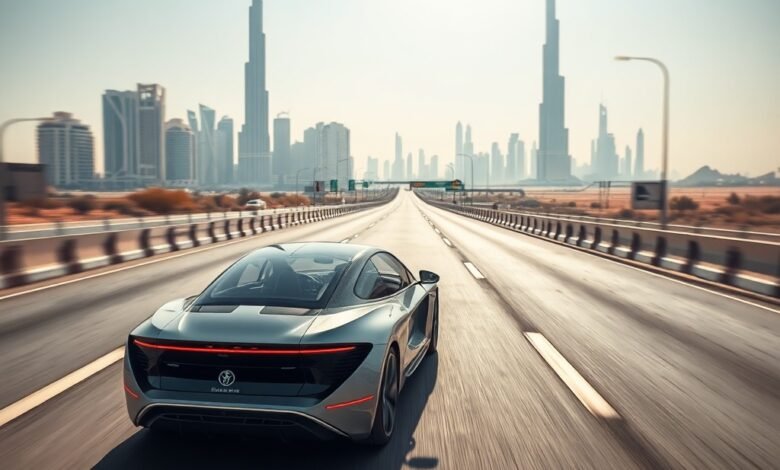
On 6 February 2026, Sheikh Hamdan bin Mohammed Al Maktoum boarded a driverless vehicle supplied by a leading autonomous‑vehicle developer partnered with the Dubai government. The high‑visibility ride is more than a publicity stunt; it crystallises a multi‑year, multi‑billion‑dollar strategy that will reshape the emirate’s transport ecosystem, reallocate capital across sectors, and create a new valuation frontier for investors.
Strategic Timing: Why February 2026 Marks a Turning Point
Government capital deployment reaches critical mass
Dubai’s autonomous‑mobility budget, announced in 2022, has escalated to an estimated US$5 billion by 2026, with 70 % earmarked for vehicle procurement, sensor‑network rollout and digital‑twin city platforms. The February demonstration coincides with the final approval of the “Driverless Roads Regulation 2026,” a comprehensive code that removes legal ambiguity for commercial fleets and unlocks private‑sector financing.
Regulatory readiness aligns with global technology cycles
International AV developers are entering a “mass‑adoption” phase in 2025‑2027, moving from pilot‑only deployments to mixed‑traffic operations. Dubai’s synchronized regulatory release ensures the emirate can capture early‑stage contracts that would otherwise flow to European or North‑American testbeds.
Scale of Investment and Market Opportunity
Projected fleet size and supporting infrastructure
By 2028, Dubai targets a fleet of 10 000 autonomous taxis and 3 000 driverless shuttles servicing the Metro, Dubai Creek and new “Smart‑District” zones. Each vehicle is expected to generate an average annual revenue of US$45 000, creating a potential US$585 million recurring revenue stream for fleet operators.
Supplier ecosystem expansion
The rollout demands 12 000 km of LiDAR‑enabled road markings, 1 500 MW of edge‑computing capacity and 4 000 + charging stations. Local construction firms, data‑center operators and renewable‑energy providers stand to win contracts worth between US$200 million and US$1 billion, accelerating diversification away from oil‑linked projects.
Implications for Automotive and Technology Companies
Domestic OEMs versus global AV platforms
UAE‑based manufacturers such as Al‑Futtaim Auto are negotiating joint‑venture agreements to assemble chassis that integrate the partner’s proprietary perception stack. For global players—Waymo, Cruise, Baidu—the Dubai deal offers a “gateway to the Gulf” and a showcase for their Level‑4 software in a climate‑controlled, high‑density environment.
Software, data and cybersecurity firms
Real‑time traffic‑optimisation algorithms will be licensed to the Roads and Transport Authority (RTA) under a US$120 million three‑year contract. Cyber‑security specialists are mandated to meet the new “Autonomous Vehicle Cyber‑Resilience Standard,” creating a niche market for compliance services projected at US$45 million annually.
Investor Outlook: Capital Flows and Valuation Upside
Sovereign wealth fund positioning
The Abu Dhabi Investment Authority (ADIA) and Mubadala have already earmarked US$800 million for a dedicated “Smart Mobility Fund.” The fund targets equity stakes in vehicle manufacturers, sensor suppliers and AI‑software firms, anticipating a 5‑7 x return by 2032 as the fleet scales.
Public‑market ripple effects
Listed entities with exposure to autonomous tech—e.g., Emirates Integrated Telecommunications (EIT) and Dubai Electricity & Water Authority (DEWA) – are projected to see a 12 % premium in market caps, driven by anticipated revenue from data‑services and energy‑management contracts linked to the AV network.
Sectoral Ripple Effects: Real Estate, Logistics, Tourism
Urban planning and “car‑lite” districts
Smart‑District masterplans now incorporate 30 % of floor‑space as “mobility‑as‑a‑service” zones, reducing parking requirements by 40 % and freeing up US$2.3 billion in developable land value for mixed‑use projects.
Last‑mile delivery and freight optimisation
Logistics firms such as Aramex are piloting autonomous cargo pods that will cut delivery costs by up to 22 % and lower carbon intensity by 15 % per kilometre, directly improving EBITDA margins in a highly competitive market.
Tourism experience and visitor spend
Dubai’s tourism authority projects that driverless shuttles linking the airport to the Expo 2025 legacy zone will increase average visitor dwell time by 0.8 days, translating into an additional US$340 million in tourism revenue annually.
Environmental and Social Governance (ESG) Leverage
Emission reductions and energy efficiency
Optimised routing and electric propulsion are expected to cut fleet‑wide CO₂ output by 18 % relative to conventional taxis, aligning with the UAE’s Net‑Zero 2050 pledge and unlocking green‑bond financing at a 0.3 % lower yield.
Safety and inclusive mobility
Autonomous sensors reduce human‑error crashes by an estimated 70 %, decreasing road‑fatality rates and insurance premiums. Moreover, the technology provides on‑demand transport for senior citizens and persons with disabilities, supporting the government’s “Inclusive Dubai” agenda.
Competitive Landscape: Dubai vs Regional Smart‑City Rivals
Benchmarking against Saudi NEOM and Qatar’s Lusail
While NEOM targets a 2029 driverless launch, its funding model relies heavily on foreign equity, exposing it to geopolitical risk. Dubai’s advantage lies in an already‑operational public‑transport backbone, a stable legal system and a proven record of rapid infrastructure delivery, giving it a 2‑year lead in commercial AV readiness.
Strategic partnerships as differentiators
Dubai’s public‑private partnership framework—mandating a 30 % local‑content clause—creates a home‑grown supply chain that NEOM’s open‑market approach lacks, potentially delivering higher domestic GDP contribution (estimated at 0.9 % of UAE GDP by 2030).
Roadmap to Full‑Scale Deployment
Pilot phases and performance milestones
Phase 1 (2026‑2027): 500 autonomous taxis operate in Downtown Dubai under a “restricted‑zone” licence, delivering a 12 % reduction in average commute times. Phase 2 (2028‑2029): integration of driverless shuttles into the Metro network, achieving a 20 % modal shift from private cars.
Policy milestones and future regulatory evolution
By late 2027, the RTA plans to issue a “Full‑Scale Commercial Licence” that removes geographic caps, enabling fleet expansion to the wider Emirate and, subsequently, to Abu Dhabi under a unified UAE AV framework.
Conclusion: A Defining Moment for UAE’s Smart‑Mobility Future
The Crown Prince’s self‑driving car ride crystallises a convergence of capital, policy and technology that will redefine urban transport in Dubai and set a benchmark for the Gulf. For investors, the signal is clear: autonomous mobility is transitioning from experimental to revenue‑generating, with multi‑sector upside that can reshape the UAE’s economic diversification trajectory for the next decade.