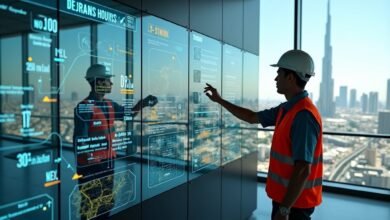
The UAE is testing new solar panel technology in Liwa Desert designed to perform in extreme desert conditions where conventional panels lose significant efficiency. The testing, conducted by Masdar in partnership with international research institutions, aims to validate solar technology specifically optimized for the Gulf’s harsh climate where summer temperatures routinely exceed 50 degrees Celsius. This trial represents one of the most ambitious real-world assessments of next-generation solar capability in the region and could determine whether the UAE meets its renewable energy targets while reducing reliance on fossil fuel power generation.
What Solar Technology Is Being Tested in Liwa
Masdar is conducting extensive field trials of high-efficiency bifacial solar panels and perovskite-silicon tandem cell technology at its Liwa Desert testing facility. These technologies differ fundamentally from standard crystalline silicon panels currently deployed across UAE solar farms. The bifacial design captures sunlight on both sides of the panel, increasing energy yield by 10 to 15 percent in high-reflectivity desert environments where sand provides excellent light reflection. The tandem cell approach layers perovskite material over traditional silicon, allowing the panel to capture a broader spectrum of sunlight and achieve conversion efficiencies exceeding 30 percent, compared to the 20 to 22 percent efficiency of conventional panels.
The testing program also includes advanced anti-soiling coatings designed to repel dust accumulation, a critical challenge in desert environments where panel cleaning represents a significant operational cost. These hydrophobic surfaces reduce dust adhesion by up to 90 percent, maintaining power output between cleanings and extending panel lifespan in sandy conditions.
Technical Specifications and Innovation
- Bifacial panel efficiency rating: 23 to 25 percent on front side, 18 to 20 percent on rear side
- Tandem cell laboratory efficiency: 33 percent, with field deployment target of 28 to 30 percent
- Temperature coefficient: minus 0.25 percent per degree Celsius, outperforming standard minus 0.4 to minus 0.5 percent
- Anti-soiling coating durability: 10-year operational lifespan with self-cleaning properties
- Panel operating temperature range: minus 40 to plus 85 degrees Celsius
- Sand resistance certification: IEC 60068 dust and sand exposure compliance
Why Liwa Desert Is the Ideal Testing Ground
Liwa Oasis, located in theEmpty Quarter of Abu Dhabi, presents the most challenging solar operating conditions on Earth. The region experiences summer temperatures reaching 52 degrees Celsius, intense sandstorms during spring months, and extremely high solar irradiance exceeding 2,200 watts per square meter at peak noon. These conditions create a rigorous validation environment where any technology weakness becomes apparent within months of deployment.
Standard silicon solar panels lose approximately 0.5 percent efficiency for every degree above 25 degrees Celsius, meaning conventional panels deployed in Liwa operate at 60 to 70 percent of their rated capacity during peak summer afternoons. The testing program targets technology that maintains at least 85 percent of rated output even at extreme temperatures, dramatically improving the economics of utility-scale solar deployment in the Gulf.
Gulf Climate Challenges for Solar Technology
The success of Liwa-tested technology would have immediate implications across the Gulf Cooperation Council region. Saudi Arabia’s 2.7 gigawatt Dumat Al Jandal wind and solar project, Qatar’s 800 megawatt Al Kharsaah solar facility, and Oman’s planned 1 gigawatt Ibri solar installation all face similar thermal and dust challenges. Technology validated in Liwa’s extreme conditions would represent the most climate-appropriate solar solution available for Gulf deployment, potentially accelerating renewable energy adoption across all six GCC states.
Dubai’s Mohammed bin Rashid Al Maktoum Solar Park, currently the largest single-site solar installation in the region, has already begun incorporating higher-efficiency panels specifically designed for desert operation. The Liwa testing results will inform procurement decisions for the final two phases of the 5 gigawatt park, representing billions of dollars in equipment purchasing.
UAE Renewable Energy Context and Strategic Goals
The UAE Energy Strategy 2050 targets 44 percent clean energy in the power mix by 2050, with solar expected to provide the majority of renewable capacity. The UAE Net Zero 2050 initiative commits the country to greenhouse gas neutrality across all sectors, requiring massive expansion of solar and other renewable generation capacity beyond current projections. Dubai’s Clean Energy Strategy 2050 aims for 75 percent clean energy in Dubai’s power grid by 2050, with solar comprising the dominant share.
Current solar installations total more than 6 gigawatts across the UAE, with another 4 gigawatts under construction or in advanced planning. The Liwa testing program directly supports these targets by validating technology that can generate more power per panel in Gulf conditions, reducing the land area and capital investment required to meet growing electricity demand from population growth, economic expansion, and the shift toward electric transportation.
Current UAE Solar Infrastructure
- Al Dhafra Solar Farm: 2.1 gigawatts capacity, the world’s largest single-site solar installation
- Noor Abu Dhabi: 1.2 gigawatts capacity, one of the largest solar plants at time of commissioning
- Mohammed bin Rashid Al Maktoum Solar Park: 5 gigawatt target capacity across six phases
- Umm Al Afak Solar Project: 1.5 gigawatts under development in Abu Dhabi
- Shams 1: 100 megawatts concentrated solar power with thermal storage
The UAE has committed approximately AED 600 billion in clean energy investments through 2050, with solar technology development representing a significant portion of research and development spending. The Liwa testing program aligns with these investments by validating next-generation technology before large-scale deployment.
What Success Looks Like and Timeline
The current testing phase, which began in early 2024, runs through mid-2026 with comprehensive performance validation expected by the fourth quarter of 2026. The program measures energy output under varying conditions including peak summer heat, spring sandstorm season, winter operational periods, and transitional shoulder seasons. Durability assessments track panel degradation rates over multiple years of continuous exposure, with successful technology required to maintain at least 90 percent of initial output after 25 years of operation.
Upon successful validation, commercial deployment could begin within 18 to 24 months, potentially supplying power to the Abu Dhabi grid by 2028 or 2029. The technology would then be available for deployment across all UAE solar projects, with potential licensing to regional partners in Saudi Arabia, Oman, and other Gulf states seeking similar desert-optimized solutions.
Industry Expert Perspectives on Desert Solar Innovation
International energy analysts have noted that desert-optimized solar technology represents a significant commercial opportunity for the UAE. Dr. Fatih Birol, Executive Director of the International Energy Agency, has stated that Gulf states possess the world’s best solar resources but require specialized technology to realize their full potential. The development of panels specifically engineered for extreme heat and dust conditions positions the UAE as a technology leader rather than merely a procurement customer for solar equipment designed for temperate climates.
Industry projections indicate that successful desert solar technology could reduce the levelized cost of energy in the Gulf by 15 to 25 percent compared to importing standard panels designed for European or Asian conditions. This cost advantage would accelerate the economic case for solar deployment across the region, supporting national diversification strategies aimed at reducing hydrocarbon dependence while maintaining energy security.
Implications for UAE and Gulf Energy Transition
Validated desert solar technology would transform the economic calculus of renewable energy investment throughout the Gulf region. Lower cost per megawatt-hour enables faster deployment timelines while meeting national targets for clean energy penetration. The UAE, which currently derives approximately 95 percent of electricity from natural gas, could realistically accelerate the transition to a majority-renewable grid within two decades rather than three, creating significant environmental and economic benefits.
Local manufacturing potential represents another significant opportunity. If deployment scales as projected, panel assembly and potentially cell manufacturing could be established in Abu Dhabi or Dubai, creating skilled employment in the renewable energy sector while reducing import dependence for critical energy infrastructure. The Mohammed bin Rashid Al Maktoum Solar Park already operates as a hub for solar technology demonstration and knowledge transfer, and successful Liwa-validated technology could expand this role.
Broader Regional Impact
The Gulf Cooperation Council’s collective solar ambitions total more than 50 gigawatts of planned capacity through 2030. Technology validated in the UAE could be deployed across the region through licensing agreements, joint ventures, or direct procurement, accelerating progress toward each nation’s stated renewable energy targets. Saudi Arabia’s Vision 2030 includes 27.5 gigawatts of renewable capacity by 2030, while Qatar’s National Environment and Climate Change Strategy targets 18 percent renewable generation by the same year.
Regional cooperation on solar technology development represents a natural extension of existing energy partnerships. The Gulf Cooperation Council Grid already enables electricity trading between member states, and shared solar resources could further enhance energy security while reducing collective carbon emissions. Successful UAE technology leadership in desert solar could establish the region as a model for hot-climate renewable energy deployment globally, with potential export markets in North Africa, South Asia, and the Middle East.
Frequently Asked Questions
What solar panel technology is being tested in Liwa Desert 2026?
Masdar is testing high-efficiency bifacial solar panels and perovskite-silicon tandem cell technology specifically designed for extreme desert conditions. The bifacial panels capture reflected sunlight from the desert floor while the tandem cells achieve higher conversion efficiency than standard silicon panels. Both technologies incorporate anti-soiling coatings to address dust accumulation, which represents a major operational challenge in desert environments.
Why is Liwa Desert used for solar panel testing in UAE?
Liwa Oasis in the Abu Dhabi desert provides the world’s most extreme real-world solar testing environment. Temperatures exceed 50 degrees Celsius during summer months, solar irradiance reaches more than 2,200 watts per square meter at noon, and sandstorms create additional environmental stress. These conditions expose any technology weakness within months, making Liwa the ideal location to validate solar panels before deployment across the Gulf region.
How does new desert solar technology differ from standard solar panels?
Desert-optimized panels feature improved temperature coefficients that reduce efficiency loss in extreme heat, anti-soiling surfaces that minimize dust accumulation, and higher base efficiencies that maintain output despite challenging conditions. Standard panels lose approximately 0.5 percent efficiency per degree above 25 degrees Celsius, while advanced desert panels maintain better performance at high temperatures, delivering 15 to 25 percent more energy in Gulf conditions.
What are UAE renewable energy targets for 2030 and 2050?
The UAE Energy Strategy 2050 targets 44 percent clean energy in the power mix by 2050, while the Dubai Clean Energy Strategy 2050 aims for 75 percent clean energy in Dubai specifically. The UAE Net Zero 2050 commitment requires greenhouse gas neutrality across all economic sectors, necessitating massive solar capacity expansion. Current UAE solar installations exceed 6 gigawatts with another 4 gigawatts under development.
When will Liwa Desert solar test results be available?
The current testing phase runs through mid-2026, with comprehensive performance validation expected by the fourth quarter of 2026. Results will inform commercial deployment decisions, with potential large-scale deployment beginning within 18 to 24 months of successful validation, delivering power to the Abu Dhabi grid by 2028 or 2029.
What major solar projects exist in Abu Dhabi and Dubai?
The Al Dhafra Solar Farm at 2.1 gigawatts is the world’s largest single-site solar installation. Noor Abu Dhabi provides 1.2 gigawatts of capacity while the Mohammed bin Rashid Al Maktoum Solar Park targets 5 gigawatts across six phases. Additional projects including the 1.5 gigawatt Umm Al Afak development and the 100 megawatt Shams 1 concentrated solar power facility round out the UAE solar portfolio.
Could this solar technology work in other Gulf countries?
Technology validated in Liwa Desert would be directly applicable across all Gulf Cooperation Council states, including Saudi Arabia, Oman, Qatar, Bahrain, and Kuwait, which share similar extreme desert conditions. The technology addresses the specific challenges of high temperatures, sand exposure, and intense solar irradiance common throughout the region, making it the most climate-appropriate solar solution available for Gulf deployment.
For the UAE, successful validation of desert-optimized solar technology would represent a transformative advancement in the nation’s clean energy transition. The combination of Liwa’s rigorous testing conditions and Masdar’s engineering expertise positions the UAE to lead regional solar innovation while achieving the ambitious renewable energy targets set by national strategy. The implications extend beyond national borders, potentially establishing Gulf cooperation on shared solar technology that accelerates the entire region’s transition away from hydrocarbon dependence.
Dubai Times will continue tracking developments in UAE solar projects, clean energy infrastructure, and technology innovation across the Gulf region. Follow our coverage for the latest updates on renewable energy deployment, desert solar technology advancements, and the broader transformation of the UAE energy landscape.