

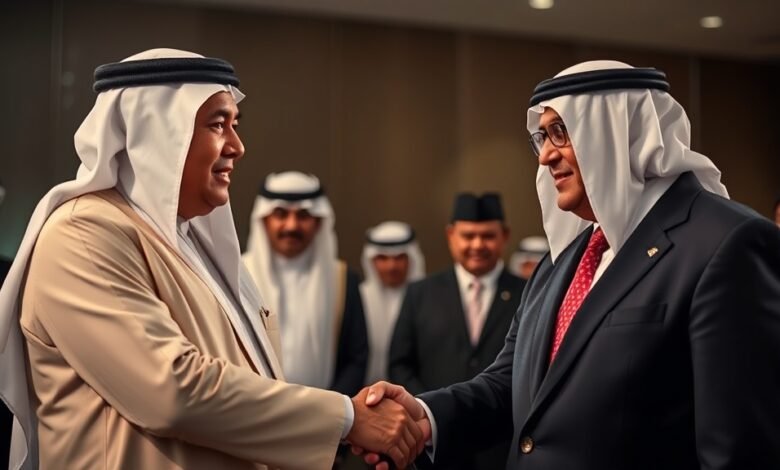
Prabowo MBZ Strategic Ties: A New Era for Indonesia‑UAE Relations
Indonesia’s defence minister Prabowo Subianto concluded a landmark three‑day visit to Abu Dhabi in early March, sealing a suite of agreements that could reshape the economic and security landscape of the Indo‑Pacific and the Gulf. The headline‑making “Prabowo MBZ strategic ties” agenda signals Jakarta’s ambition to become a bridge between Gulf capital and Southeast Asian markets while deepening Indonesia’s role in regional security architecture.[1]
Key Highlights of the Prabowo MBZ Strategic Ties
- MoU establishing a $5 billion joint investment fund for Indonesian ports, railways and digital infrastructure.
- Defence cooperation framework covering maritime patrols, cyber‑security and joint counter‑terrorism training.
- Renewable‑energy joint‑venture to develop solar farms in Java and Sumatra, backed by Abu Dhabi’s sovereign wealth fund.
- Commitment to boost Gulf‑Indonesia trade by 30 % over the next five years.
- Launch of a cultural‑exchange programme targeting youth, diaspora communities and tourism.
Background of the Prabowo MBZ Strategic Ties
The Abu Dhabi diplomatic visit built on a series of high‑level exchanges that began in 2022, when Indonesia and the United Arab Emirates signed a bilateral cooperation pact focused on energy and construction.[2] Prabowo arrived with a delegation that included senior defence officials, trade ministers, and representatives of the Indonesian diaspora in the Gulf. Their mandate was clear: expand the traditional economic relationship into a comprehensive strategic partnership that covers security, technology and people‑to‑people links.
Economic Pillars of the Agreement
The centerpiece of the economic package is a $5 billion investment fund earmarked for modernising Indonesia’s ports, railways and digital corridors. The fund will be co‑managed by Indonesia’s Ministry of Finance and Abu Dhabi’s sovereign wealth fund, Mubadala.[3] Early projects include the expansion of the Tanjung Priok container terminal and the construction of a high‑speed rail line linking Jakarta to Bandung.
In addition, the two sides signed a renewable‑energy MoU that will finance solar‑power plants with a combined capacity of 2 GW. The initiative aligns with Indonesia’s target of generating 23 % of its electricity from renewables by 2025.[4]
Trade analysts estimate that the new framework could lift bilateral trade from the current $15 billion to over $20 billion by 2029, driven by increased UAE investment in infrastructure and greater market access for Indonesian commodities such as palm oil, coffee and textiles.[5]
Security and Defence Cooperation
Security was a cornerstone of the Prabowo MBZ strategic ties dialogue. Both governments approved a joint maritime‑security initiative that will deploy Indonesian and Emirati patrol vessels in the Strait of Malacca and the Indian Ocean to combat piracy, illegal fishing and smuggling.[6] A counter‑terrorism task force will share intelligence on extremist networks operating across Southeast Asia and the Gulf, with a focus on disrupting financing channels.
The defence framework also includes joint cyber‑security exercises, the establishment of a shared training centre in Jakarta, and the exchange of senior officers to foster interoperability.[7]
Geopolitical Implications
The deepening of ties comes at a time when the UAE is expanding its diplomatic outreach beyond the traditional Gulf bloc. By aligning with Indonesia—the world’s largest Muslim‑majority nation—Abu Dhabi strengthens its influence within the Organisation of Islamic Cooperation (OIC) and positions itself as a strategic partner in the Indo‑Pacific.[8]
For Jakarta, the partnership offers a platform to voice Southeast Asian concerns in Gulf forums and to diversify its foreign‑policy portfolio amid a delicate balancing act between China and the United States.[9] The “strategic bridge” narrative also resonates with Indonesia’s “global maritime fulcrum” vision, which seeks to secure sea lanes that carry more than 80 % of the world’s trade.[10]
Cultural and People‑to‑People Links
Beyond economics and security, the agreement includes a robust cultural‑exchange programme. Emirati scholarships will fund Indonesian students in engineering, renewable‑energy and maritime studies, while Indonesia will host a series of cultural festivals in Abu Dhabi showcasing Batik, gamelan and traditional cuisine.
The diaspora community—estimated at over 100,000 Indonesians living in the UAE—will benefit from new consular services, business networking events and a streamlined visa‑on‑arrival scheme for tourists from both countries.[11]
Challenges, Criticisms and Transparency Concerns
Human‑rights organisations have raised concerns about the UAE’s record on freedom of expression and labour rights, urging Jakarta to weigh ethical considerations against economic gains.[12] Domestically, opposition parties in Indonesia have called for greater parliamentary oversight of the defence agreements, citing a lack of transparency in the MoU’s financial details.[13]
Strategically, Indonesia must ensure that deeper Gulf ties do not tilt its delicate balance between China’s Belt‑and‑Road investments and the United States’ Indo‑Pacific security umbrella.[14]
Future Outlook and Next Steps
Follow‑up meetings are scheduled for later this year, including a joint Indonesia‑UAE summit in Dubai to review progress on the investment fund and security initiatives. Both governments are drafting a long‑term partnership roadmap that envisions a multilateral forum bringing together Gulf and ASEAN nations to discuss trade, climate action and maritime safety.[15]
The trajectory of the Prabowo MBZ strategic ties will likely set the tone for future Gulf‑Indonesia collaborations, influencing regional trade patterns, security cooperation and diplomatic alignments for years to come.
Conclusion
The Prabowo MBZ strategic ties represent a decisive shift from a purely transactional relationship to a multidimensional partnership. By combining a $5 billion infrastructure fund, joint maritime security, renewable‑energy projects and vibrant cultural exchanges, Indonesia and the UAE are forging a model of cooperation that could redefine Gulf‑Southeast Asian relations. While challenges remain—particularly around human‑rights concerns and the need for transparent governance—the partnership offers both nations a strategic lever to enhance economic growth, safeguard sea lanes and amplify their voices on the global stage.
Frequently Asked Questions
What are the main components of the Prabowo MBZ strategic ties?
The partnership includes a $5 billion joint investment fund for infrastructure, a defence cooperation framework for maritime and cyber security, a renewable‑energy joint venture, trade‑boosting measures, and cultural‑exchange programmes.
How will trade between Indonesia and the UAE change?
Trade is expected to grow by up to 30 % within five years, driven by increased UAE investment in ports and railways and expanded market access for Indonesian commodities such as palm oil, coffee and textiles.
What security initiatives were announced?
Both sides launched a joint maritime patrol program in the Strait of Malacca, a counter‑terrorism intelligence task force, and a series of cyber‑security exercises to protect key sea lanes.
Are there any concerns about the partnership?
Human‑rights groups have flagged the UAE’s record on freedom of expression, and Indonesian opposition parties are demanding greater parliamentary oversight of the defence agreements.
References
- Al‑Jazeera, “Indonesia‑UAE defence talks mark new strategic era,” March 2024.
- The Jakarta Post, “Bilateral cooperation pact signed in 2022,” Dec 2022.
- Mubadala Annual Report 2023, p. 42.
- Indonesia Ministry of Energy & Mineral Resources, Renewable Energy Roadmap 2025.
- World Bank Trade Statistics, 2023.
- International Maritime Organization, “Piracy trends in the Indian Ocean,” 2024.
- UAE Ministry of Defence, Joint Cyber‑Security Statement, March 2024.
- OIC Secretariat, “Member State Engagements,” 2024.
- Council on Foreign Relations, “Indonesia’s great power balancing act,” Jan 2024.
- Indonesia Ministry of Foreign Affairs, “Global Maritime Fulcrum” policy paper, 2023.
- UAE Embassy Jakarta, “Consular Services Expansion,” Feb 2024.
- Human Rights Watch, “UAE: Freedom of Expression Under Threat,” 2023.
- Kompas, “Parliament calls for defence MoU audit,” March 2024.
- Brookings Institution, “Indonesia’s strategic choices in a multipolar world,” 2024.
- Gulf‑ASEAN Forum Draft Agenda, 2024.