Dubai Rent Increase Calculator 2026: How Much Can Your Landlord Raise Rent?
Check how much your landlord can raise your rent at renewal. This guide explains how to use the official DLD calculator, check the notice deadline and challenge a proposed increase.
In this article
- What Is the Dubai Rent Increase Calculator?
- How Much Can a Landlord Increase Rent in Dubai in 2026?
- How to Use the RERA Rent Increase Calculator in Dubai
- Dubai Rent Increase Calculation Examples
- What Is Dubai's Smart Rental Index?
- Is a 90-Day Notice Required for a Rent Increase in Dubai?
- Can Your Landlord Increase Rent During an Existing Tenancy Contract?
- Can a Landlord Increase Rent Above the RERA Calculator Limit?
- What Should You Do If Your Landlord Demands an Unfair Rent Increase?
- What if the Landlord Refuses to Renew Your Tenancy Contract?
- Can a Landlord Evict a Tenant for Refusing a Rent Increase?
- Does a New Tenant Pay the Same Rent as an Existing Tenant?
- Can Tenants Ask for a Rent Reduction in Dubai?
- Common Mistakes to Avoid When Checking a Dubai Rent Increase
- Frequently Asked Questions About Dubai Rent Increase Rules
- Final Thoughts: Check the Official Calculator Before You Agree to Higher Rent
Last updated: November 19, 2026
Your tenancy contract is about to expire, and your landlord has sent you a renewal offer with a higher rent. Maybe the increase is AED 5,000. Maybe it's AED 15,000. Before you agree to pay more or start looking for another apartment, there's something worth checking: Is your landlord legally allowed to increase your rent by that amount?
In Dubai, landlords cannot simply choose a new rental price because nearby apartments are advertised for more. Rent increases at renewal are controlled by specific rules, and the Dubai Rent Increase Calculator helps tenants and property owners understand what is permitted.
Under Dubai's rent increase framework, the maximum increase generally ranges from 0% to 20%, depending on how the existing rent compares with the official rental value of similar properties. Landlords must also follow the applicable notice requirements.
This guide explains how to use the official RERA rental calculator in 2026, calculate your possible new rent, check your landlord's notice and understand what to do when a proposed increase seems unfair.
What Is the Dubai Rent Increase Calculator?
The Dubai Rent Increase Calculator is an online service provided by the Dubai Land Department (DLD). It helps landlords and tenants check whether a rental increase is permitted when renewing a tenancy agreement.
It is often called the RERA Rental Calculator because the Real Estate Regulatory Agency (RERA) is part of Dubai's real estate regulatory system.
The calculator uses the official Rental Index to compare your current rent with the applicable rental value for similar properties.
The result helps you understand whether your landlord can increase the annual rent and, if so, by what percentage.
For example, a tenant paying AED 70,000 annually might receive a renewal proposal of AED 80,000. Instead of relying on the landlord's estimate or prices shown on property listing websites, the tenant can check the official calculator.
If the calculator allows only a 5% increase, the maximum increase under that result would be AED 3,500, bringing the annual rent to AED 73,500.
The official result is the starting point for checking the proposed increase.
Official service: Dubai Land Department Rental Index Calculator
How Much Can a Landlord Increase Rent in Dubai in 2026?
Dubai's rent increase limits are established under Decree No. 43 of 2013, which sets maximum increases according to the difference between the current rent and the average rental value of similar properties.
The following limits form the basis of the calculation:
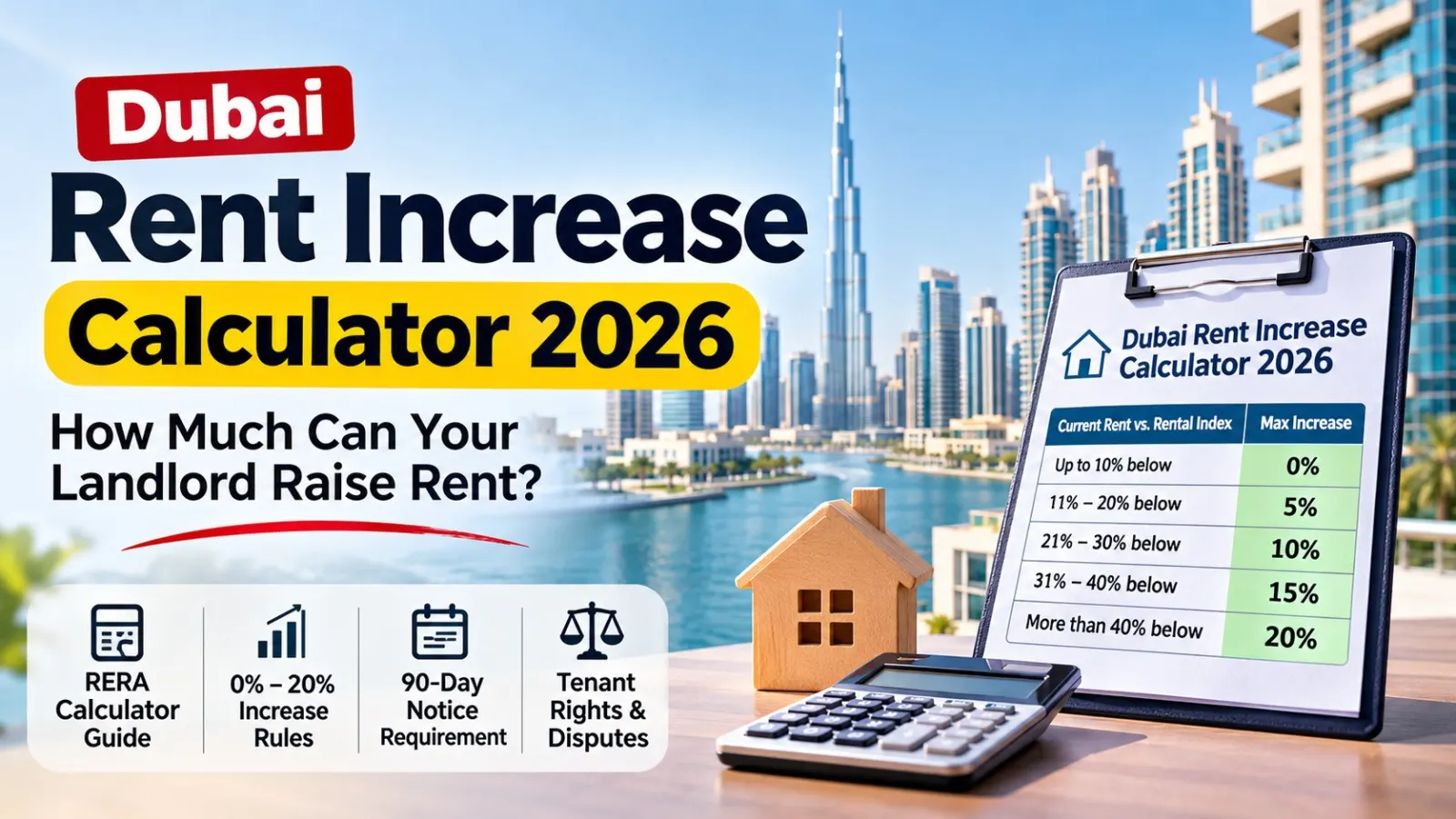
| Current Rent Compared With Official Average | Maximum Permitted Increase |
|---|---|
| At or above the average, or up to 10% below | 0% |
| 11% to 20% below the average | 5% |
| 21% to 30% below the average | 10% |
| 31% to 40% below the average | 15% |
| More than 40% below the average | 20% |
These are the percentage bands stated in the decree. For a real renewal, use the official calculator to determine the applicable band, especially when the comparison falls near a boundary.
Can a landlord increase rent by 20% in Dubai?
Yes, but a 20% increase is not automatically permitted.
Under the decree, the highest increase band applies when the current rent is more than 40% below the applicable average rental value of similar properties.
A landlord cannot apply the highest percentage simply because property prices have increased across Dubai.
Can a landlord increase rent by 10% every year?
No. There is no automatic right to increase rent by 10% every year.
The permitted percentage depends on the official Rental Index result for the relevant renewal. A property that qualifies for an increase one year may fall into a different band at a later renewal.
What if the calculator shows 0%?
If the official calculator shows that no increase is permitted, the landlord cannot simply impose a higher renewal rent under the standard rent increase framework.
The landlord and tenant may discuss the terms, but a disputed increase should be handled according to the applicable tenancy law and dispute procedures.
How to Use the RERA Rent Increase Calculator in Dubai
You can check your rental increase through the Dubai Land Department website without relying on a third-party estimate.
Step 1: Visit the Dubai Land Department website
Open the official DLD Rental Index service.
The website provides the rental calculation service for different property categories.
Step 2: Select your property type
Choose the relevant property category. For a residential tenancy, you may need to identify whether your home is an apartment, villa or another available residential type.
Check that the selected category matches your rental contract.
Step 3: Enter your tenancy contract expiry date
Provide the date your current tenancy agreement ends.
This is important because the calculation is being performed for a particular renewal period.
Step 4: Choose how to identify your property
Depending on the available options, you may be able to search using:
- Your Ejari contract number
- Your DEWA premises or municipality details
- Your residential area and property information
If you use the area-based option, the service may request additional details such as the number of bedrooms or property size.
Step 5: Enter your current annual rent
Enter the yearly rental amount stated in your contract.
For example, if you pay AED 6,000 every month, your annual rent is AED 72,000.
Be careful not to enter your monthly rent when the calculator asks for the annual amount.
Step 6: Calculate the permitted increase
Complete the required fields and select Calculate.
Review the result to see whether an increase is applicable and what the service permits.
For your records, save a screenshot or copy of the result showing the relevant information and date.
If you are discussing a renewal with your landlord, checking the result again closer to the renewal date may also be useful.
Dubai Rent Increase Calculation Examples
A percentage may look small until you calculate what it means for your annual housing budget.
The following examples show how Dubai's rental increase bands work. They are illustrations, not live DLD results for actual apartments.
| Current Annual Rent | Illustrative Index Average | Gap Below Average | Maximum Increase | Maximum New Annual Rent |
|---|---|---|---|---|
| AED 90,000 | AED 100,000 | 10% | 0% | AED 90,000 |
| AED 85,000 | AED 100,000 | 15% | 5% | AED 89,250 |
| AED 75,000 | AED 100,000 | 25% | 10% | AED 82,500 |
| AED 65,000 | AED 100,000 | 35% | 15% | AED 74,750 |
| AED 55,000 | AED 100,000 | 45% | 20% | AED 66,000 |
How is the percentage gap calculated?
If you have the correct official average rental value, the basic comparison is:
Percentage Below Average = (Average Rental Value − Current Annual Rent) ÷ Average Rental Value × 100
Suppose your annual rent is AED 75,000 and the official average is AED 100,000.
The difference is AED 25,000, which is 25% of the average rental value.
This places the example in the 10% maximum increase band.
The maximum increase would therefore be:
AED 75,000 × 10% = AED 7,500
Maximum new annual rent: AED 82,500
Remember that the increase percentage applies to the existing rent, not to the market average.
The manual formula is useful for understanding the calculation, but it does not replace the official DLD result.
What Is Dubai's Smart Rental Index?
Dubai Land Department introduced the Smart Rental Index 2025 on January 2, 2025, to improve the way residential rental values are assessed.
The system uses building classifications and property information rather than depending only on broad neighbourhood averages.
Factors considered by the index include building construction quality, finishes, maintenance, location, facilities and other technical or service-related characteristics.
For tenants, this matters because two apartment buildings in the same neighbourhood may not necessarily have identical rental assessments.
A building with different facilities, maintenance standards or property characteristics may receive a different classification.
The Smart Residential Rent Index is updated annually, according to Dubai Land Department's published FAQs.
Although people continue to call it the RERA calculator, the official DLD Rental Index is the service to use for checking a current renewal.
Does the Smart Rental Index cover every property in Dubai?
According to Dubai Land Department, the Smart Residential Rent Index covers residential areas across Dubai, including privately developed areas and free zones, but excludes the Dubai International Financial Centre (DIFC).
Decree No. 43 of 2013 separately states that its rent increase provisions extend to free zones, including DIFC.
That distinction matters: the decree's stated scope and the coverage of the DLD Smart Residential Rent Index are not identical. Tenants in DIFC should check the applicable tenancy rules and dispute procedures for their property rather than assuming the standard DLD residential calculator will provide their result.
Is a 90-Day Notice Required for a Rent Increase in Dubai?
Generally, yes.
Under Article 14 of Law No. 26 of 2007, as amended by Law No. 33 of 2008, a party wishing to change the tenancy agreement's terms at renewal must notify the other party at least 90 days before the contract expires, unless the parties have agreed otherwise.
This requirement applies to proposed changes in tenancy terms, including rent adjustments.
For example, suppose your contract ends on March 31, 2027.
Counting back 90 calendar days gives December 31, 2026.
Unless a different arrangement has been agreed, the landlord should communicate the proposed change by the applicable notice deadline.
What if the landlord gives only 30 or 60 days' notice?
If your landlord requests a rent increase shortly before renewal, check the notice provision in your tenancy agreement.
Where the standard 90-day requirement applies and no different arrangement has been agreed, a late notice may provide grounds to challenge the increase for that renewal.
Do not assume that the landlord can bypass the notice requirement just because the Rental Index permits a higher amount.
Can a landlord increase the rent without any notice?
Under the standard statutory notice framework, a landlord cannot unilaterally impose a changed renewal term without complying with the applicable notice requirement.
However, Article 14 expressly allows the parties to agree otherwise. The exact lease terms and communications may affect a dispute.
Is a WhatsApp or email rent increase notice valid?
Dubai's Rental Disputes Center recognises that WhatsApp messages, emails and other electronic communications can be used as evidence in rental disputes, subject to the relevant conditions.
That does not mean every informal message automatically proves that a valid notice was served.
The content, timing, delivery, authenticity and contractual terms may all matter.
Tenants and landlords should keep copies of their written communications, including dates and any replies.
Can Your Landlord Increase Rent During an Existing Tenancy Contract?
The standard Dubai rent increase framework concerns lease renewals.
A landlord generally cannot unilaterally change the agreed rent during an ongoing fixed-term tenancy simply because market prices have increased.
For example, if you signed a one-year contract at AED 80,000, the landlord cannot ordinarily demand AED 90,000 halfway through the agreed term without a valid legal or contractual basis.
Both parties should review the signed agreement before accepting any proposed mid-contract change.
Can a Landlord Increase Rent Above the RERA Calculator Limit?
A landlord cannot unilaterally impose an increase that exceeds the applicable legal cap simply by referring to higher advertised rents.
Suppose you currently pay AED 80,000 annually.
Your landlord proposes AED 92,000 for renewal, which represents a 15% increase.
However, the official calculator permits only a 5% increase.
Based on that result, the maximum rent under the standard increase framework would be AED 84,000.
The proposed AED 92,000 exceeds that figure by AED 8,000.
You can ask the landlord to explain the calculation and provide your own official Rental Index result.
If you cannot agree on the legally applicable renewal terms, the Rental Disputes Center can consider the dispute.
A calculator result does not remove the need to consider notice requirements or the particular facts of a case.
What Should You Do If Your Landlord Demands an Unfair Rent Increase?
Receiving a renewal proposal that appears to exceed the permitted amount can be stressful, especially when your family has been living in the property for several years.
The best response is to check the facts and communicate clearly.
1. Check the official Rental Index
Use the Dubai Land Department calculator to confirm the permitted increase.
Avoid relying solely on an estate agent's estimate, a property portal advertisement or a calculation based on last year's rental data.
2. Review your tenancy agreement
Check the expiry date, current rent, renewal terms and any agreed provisions about notice.
Also review when and how the landlord informed you of the proposed increase.
3. Respond to the landlord in writing
You can explain that you have reviewed the official calculator and ask the landlord to reconsider the proposed amount.
Keep the conversation polite and factual.
A useful response might be:
"Thank you for sharing the renewal proposal. I checked the Dubai Land Department Rental Index for our tenancy details, and the result indicates a lower permitted increase. Could we please review the renewal amount using the official calculation?"
4. Keep supporting documents
Save your Ejari, tenancy contract, rent payment records, renewal notice, relevant messages and Rental Index result.
These documents may become important if a formal dispute arises.
5. Contact the Rental Disputes Center if necessary
If the matter remains unresolved, check the available services through the Dubai Rental Disputes Center.
The center offers formal procedures for addressing rental disputes, including an amicable settlement service.
Do not stop paying rent or ignore payment deadlines simply because you disagree with a proposed increase. Seek appropriate advice about how to protect your payment position.
What if the Landlord Refuses to Renew Your Tenancy Contract?
A landlord refusing to sign a renewal does not automatically mean the tenant must leave immediately.
Dubai tenancy law contains provisions addressing renewal, continued occupancy and the circumstances in which a landlord may seek eviction.
The Rental Disputes Center also provides an Offer and Deposit service.
This procedure may be relevant where a tenant is attempting to offer rent and the landlord refuses to accept it.
Applications are subject to judicial review and prescribed requirements. Filing an application does not guarantee a particular outcome.
The official procedure may require copies of the tenancy agreement, identification, payment documents and communications between the parties.
Tenants should seek guidance on the appropriate procedure rather than withholding rent or assuming that filing a request automatically renews the tenancy.
Official service: Register an Offer and Deposit
Can a Landlord Evict a Tenant for Refusing a Rent Increase?
Disagreeing with a proposed rent increase does not, by itself, establish that the landlord has a valid reason to evict the tenant.
Dubai law identifies specific grounds and procedures for eviction.
Under Article 25 of the amended tenancy law, a landlord may seek eviction at the end of a lease for certain reasons, including selling the property, qualifying personal use, demolition or major renovation, subject to legal conditions.
For these specified end-of-tenancy eviction grounds, the law requires a 12-month notice served through a Notary Public or by registered mail.
This is different from the 90-day notice generally required for changes to tenancy terms.
The law also addresses eviction during a contract for certain breaches, including non-payment after the required notice and opportunity to pay.
A tenant should therefore distinguish between a lawful eviction process and pressure to accept a disputed increase.
Does a New Tenant Pay the Same Rent as an Existing Tenant?
Not necessarily.
An existing tenant renewing a contract and a new tenant negotiating a fresh tenancy are in different situations.
The rent increase caps under Decree No. 43 of 2013 specifically address the renewal of real property lease contracts.
A newly advertised apartment may have an asking price higher than the rent paid by an existing tenant in the same building.
That advertised amount does not automatically determine the maximum increase for an existing tenant.
For example, suppose your neighbour's apartment is being advertised for AED 110,000, while you currently pay AED 85,000.
Your landlord might use the listing to argue that your rent should increase substantially.
However, the relevant renewal calculation should be checked through the official Rental Index. A listing price alone is not proof that the proposed increase is legally permitted.
Can Tenants Ask for a Rent Reduction in Dubai?
Yes. Tenants can negotiate for a lower rent when renewing their tenancy.
For example, if comparable apartments are being offered for less, you may ask your landlord to review your rental rate.
The official Rental Index, recent comparable rental evidence and property condition may help inform that discussion.
However, a lower market average does not automatically reduce an existing tenant's rent.
If the landlord and tenant cannot agree on the applicable renewal rent, the legal framework provides for disputes to be considered by the competent rental tribunal.
A tenant seeking to change the rent at renewal should also consider the notice requirements under Article 14.
Common Mistakes to Avoid When Checking a Dubai Rent Increase
Many rental disagreements begin with a misunderstanding of how the increase is calculated.
Using advertised rental prices instead of the official index: A listing on a property website may be useful for market research, but it is not a replacement for the DLD Rental Index.
Calculating the increase against the market average: The legal percentage increase is applied to the current rent, not the average market rent.
Assuming a 20% increase is always allowed: Twenty percent is the highest band, not a standard annual increase.
Ignoring the notice period: A permitted percentage does not automatically resolve whether the landlord complied with the applicable notice requirement.
Using outdated calculator results: Rental data can change. Check the official result for the relevant renewal.
Confusing rent notices with eviction notices: A 90-day notice to change tenancy terms is not the same as a 12-month notice used for specified eviction grounds.
Stopping rental payments during a dispute: Disputing an increase does not remove a tenant's payment obligations. Use the appropriate legal procedure when payment is refused or disputed.
Frequently Asked Questions About Dubai Rent Increase Rules
1. How much can my landlord increase rent in Dubai in 2026?
Under Decree No. 43 of 2013, the maximum increase at renewal can be 0%, 5%, 10%, 15% or 20%, depending on how far the current rent is below the official average rental value of similar properties. Check the DLD Rental Index for your specific property.
2. Is the Dubai Rent Increase Calculator free?
Dubai Land Department provides an online Rental Index service that tenants and landlords can use to check the applicable rental increase without paying a calculator access fee.
3. How can I check my RERA rent increase online?
Visit the official Dubai Land Department Rental Index website, enter the requested property and tenancy information, including your current annual rent, and calculate the permitted increase.
4. Can a landlord increase rent every year in Dubai?
A landlord may propose an increase at renewal, but it must comply with the applicable rental cap, notice requirements and tenancy terms. An annual increase is not automatic.
5. What is the maximum rent increase allowed in Dubai?
The highest percentage under Decree No. 43 of 2013 is 20% of the current rent, where the applicable conditions for that band are satisfied.
6. Can my landlord increase my rent by 15%?
A 15% increase may be permitted when the current rent is 31% to 40% below the applicable average rental value and the relevant legal requirements are satisfied. The actual result should be checked through DLD.
7. Can my landlord increase rent without 90 days' notice?
Article 14 generally requires at least 90 days' notice for a proposed change in tenancy terms at renewal, unless the parties agreed otherwise. The individual tenancy agreement and circumstances should be reviewed.
8. What if my landlord gives an increase notice after the deadline?
If the standard 90-day rule applies and the notice was late, you may have grounds to contest the proposed increase for that renewal. Keep the notice and consult the Rental Disputes Center where necessary.
9. Is the RERA calculator different from the DLD Rental Index?
People often use both terms for the official rent-checking service. The current online Rental Index service is provided by the Dubai Land Department.
10. Does a rent increase require a new Ejari?
When a tenancy is renewed, the renewed agreement should be registered through the applicable Ejari process. A proposed rent increase alone is not a replacement for a properly documented renewal.
11. Can my landlord evict me because I reject an increase?
Rejecting a proposed increase does not automatically create a lawful eviction ground. Eviction is subject to the applicable legal grounds and procedures, and unresolved tenancy disputes may require a decision from the competent authority.
12. Does the rental calculator apply to villas in Dubai?
The DLD Rental Index service provides options for different property categories, including residential property types such as apartments and villas. Select the correct category and enter the required information.
13. What if my apartment is not listed in the rental index?
First check that you have entered the correct property information. Some new buildings may need to be registered and classified in the DLD system. If the property still cannot be found, contact Dubai Land Department through its official support channels.
14. Can my rent decrease if the Dubai rental market falls?
A tenant can request a reduction at renewal, but a lower market rate does not automatically reduce the contractual rent. A reduction may be agreed between the parties or considered through the appropriate dispute process.
15. Where can I complain about an illegal rent increase in Dubai?
You can approach the Dubai Rental Disputes Center, which provides services for rental disagreements and amicable settlements. Keep your lease, Ejari, notice, payment records and official calculator result.
Final Thoughts: Check the Official Calculator Before You Agree to Higher Rent
A rent increase can have a significant effect on your household budget, especially when you are already paying for utilities, school fees, transport and other living expenses in Dubai.
Before accepting a higher renewal amount, check the official Dubai Rent Increase Calculator, review the notice received from your landlord and understand the permitted percentage for your property.
A 20% increase is not an automatic entitlement, and a higher asking rent in the same neighbourhood does not necessarily justify raising an existing tenant's rent by the same amount.
If the proposed increase does not match the applicable rules, discuss the issue with your landlord and keep records of the communication. Where the disagreement cannot be resolved, use the official dispute procedures.
Check your permitted rent increase: Dubai Land Department Rental Index
Official Sources and Legal References
- Dubai Land Department: Rental Index Calculator
- Dubai Land Department: Smart Rental Index Announcement
- Dubai Land Department: Frequently Asked Questions
- Decree No. 43 of 2013: Determining Rent Increase
- Law No. 33 of 2008: Dubai Tenancy Law Amendments
- Dubai Rental Disputes Center
Editorial note: This article provides general information about Dubai rental rules as checked on November 19, 2026. It is not legal advice. The official Rental Index result, current legislation, tenancy terms and any decision by the competent authority should be considered for an individual case.
For more practical resident guides, see Living in the UAE.
Official sources
Keep reading
More in Living in the UAE
How to File a Labour Complaint in UAE Through MOHRE: 2026 Guide
How to file and track a private-sector labour complaint through MOHRE, with documents, fees, deadlines and what happens after filing.

ILOE Insurance UAE 2026: How to Check Fines, Renew and Claim Benefits
Check your ILOE policy and fines, renew your cover and learn how to claim unemployment benefits through the official UAE services.

UAE Travel Ban Check Online 2026: Dubai Police, Abu Dhabi and Official Methods
Find the official travel ban enquiry for your emirate or case, what ID you need and what to do if a restriction appears.