Dubai Mainland vs Free Zone in 2026: Which Business Setup Is Better?

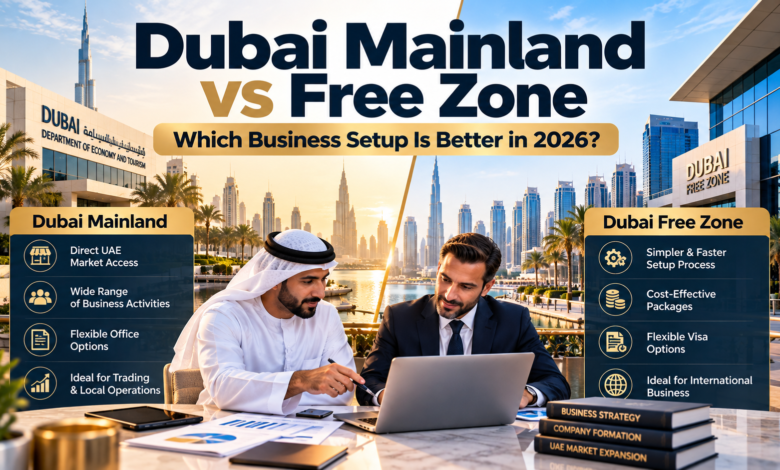
Choosing between a Dubai mainland company and a free zone company used to be a relatively simple decision. Mainland businesses offered broader local-market access, while free zones were usually chosen for international trade, specialised ecosystems and simplified setup.
In 2026, that distinction is less rigid.
Dubai has introduced new operating options that allow eligible free-zone companies to access parts of the mainland market through structured permits, while mainland companies continue to benefit from broad domestic operating flexibility.
That means entrepreneurs should no longer ask only, “Which one is cheaper?” The better question is: Which structure fits how the business will actually earn revenue, hire staff, use office space and serve customers?
What Is a Dubai Mainland Company?
A mainland company is licensed through the Dubai Department of Economy and Tourism, or DET.
DET currently offers several licence categories, including:
- Commercial Licence
- Professional Licence
- Industrial Licence
- E-Trader Licence
- Dual Licence
The authority’s business-licensing platform allows investors to select activities, reserve a trade name, receive the required approvals and complete the licence process.
A mainland setup is typically considered when a company expects to operate directly across Dubai and the wider UAE market, lease conventional commercial premises, hire a larger team or conduct activities better suited to DET licensing.
What Is a Dubai Free Zone Company?
A free zone company is established under one of Dubai’s designated free-zone authorities rather than directly through DET.
Each free zone has its own:
- licence categories
- activities
- office requirements
- visa rules
- registration fees
- operating conditions
Dubai free zones range from broad entrepreneurial jurisdictions to highly specialised business districts.
For example, Meydan Free Zone currently offers digital company formation from AED 12,500, including a licence, flexi-desk and up to three activity groups, with visas charged separately.
DMCC, by comparison, operates a more structured commercial ecosystem with office requirements tied to activity and staffing needs. Its company setup guidance makes clear that businesses must maintain appropriate premises within the DMCC Free Zone.
This illustrates an important point: “free zone” is not one single business model.
The Biggest Change: Free Zone Companies Can Now Access the Mainland More Easily
One of the most important developments in Dubai’s company-formation landscape came in October 2025.
Dubai’s Department of Economy and Tourism launched the Free Zone Mainland Operating Permit, a framework allowing eligible free-zone companies to operate in Dubai mainland through a structured permit system.
DET stated that the framework potentially opens mainland access to more than 10,000 free-zone companies and can allow qualifying businesses to engage in domestic trading and pursue government contracts.
The initiative was introduced under Dubai Executive Council Decision No. 11 of 2025.
This changes the old assumption that a free-zone company must always establish a separate mainland entity to conduct meaningful local business.
However, it does not mean every free-zone company automatically has unrestricted mainland access. Eligibility, activities and permit conditions still matter.
Mainland vs Free Zone: The Main Difference in 2026
The distinction is now less about “local versus international” and more about how much flexibility the business needs and under which regulatory structure it wants to operate.
A mainland setup usually provides broader direct domestic operating flexibility.
A free-zone setup may provide:
- simpler digital incorporation
- specialised ecosystems
- flexible workspace
- sector-specific infrastructure
- bundled licensing packages
- eligibility for specific free-zone tax treatment
The new mainland operating permit gives certain free-zone companies additional flexibility, but it does not make the two structures identical.
Which Is Better for Trading Businesses?
A mainland structure can still be the more straightforward option for companies whose primary business model depends heavily on direct UAE trading.
This may include businesses involved in:
- wholesale
- retail
- local distribution
- physical trading operations
- local warehouses
- domestic supply chains
DET’s Commercial Licence is specifically designed for trading activities including import/export, wholesale and retail.
A free-zone company may still work for some trading models, particularly where the business is import/export focused or uses the new mainland permit framework.
The key question is where the customers are and how goods will move.
Which Is Better for Consultants and Digital Businesses?
For a small consultancy, technology company, digital agency or remote-first service business, a free zone can be more efficient.
Free zones often provide:
- digital setup
- flexi-desk arrangements
- lower initial office requirements
- zero-visa licence options
- bundled activity packages
Meydan Free Zone, for example, currently allows a zero-visa licence with a lease agreement and permits up to three activity groups under one licence.
For a founder who does not need a conventional office, retail unit or large local workforce, that flexibility can reduce unnecessary overhead.
A mainland setup may still be preferable where the service company needs unrestricted local contracting or significant onshore operations.
Office Requirements Can Change the Decision
Office space is one of the most important practical differences.
A mainland company may need premises suitable for its activity and operating model.
Free-zone requirements vary significantly.
Some zones allow flexi desks or shared offices, while others require larger dedicated space as the business grows.
DMCC, for example, states that office requirements depend on employee numbers and activity. Its guidance also notes that companies must maintain premises within the DMCC Free Zone rather than simply licensing there and operating from an unrelated location.
Entrepreneurs should therefore ask:
- Is a physical office required?
- Is a flexi desk enough?
- How does office size affect visa allocation?
- Can the company upgrade later?
- What does renewal cost?
These questions often matter more than the headline licence price.
Visa Requirements Also Differ
Mainland and free-zone companies can both sponsor eligible visas, but the mechanics can differ.
Free zones commonly tie visa allocation to the selected package or workspace.
Meydan currently lists separate charges for visa allocation and residency processing, while DMCC requires an active licence and establishment card before employee residence visa applications can be submitted.
A founder expecting to remain a one-person business may prefer a low-overhead free-zone package.
A company planning a larger team should compare:
- visa quotas
- office requirements
- employee costs
- immigration fees
- future expansion limits
The cheapest company setup can become expensive if the business outgrows its initial visa or workspace allocation quickly.
100% Foreign Ownership Is No Longer a Free-Zone-Only Advantage
One of the old arguments for free-zone setup was full foreign ownership.
That distinction is much weaker today.
Many mainland activities also allow 100% foreign ownership, subject to the exact activity and applicable regulations.
DET explicitly directs investors to check ownership restrictions for activities that do not qualify for full foreign ownership.
This means foreign investors should not choose a free zone simply because they assume a mainland company requires an Emirati shareholder.
The activity should be checked first.
What About Corporate Tax?
Tax is one of the most misunderstood areas in mainland vs free-zone comparisons.
A free-zone company is not automatically tax-free.
The Federal Tax Authority states that a Qualifying Free Zone Person must meet specific conditions, including adequate UAE substance, qualifying income requirements and transfer-pricing compliance.
Where the conditions are satisfied, the current free-zone corporate tax regime provides:
- 0% on Qualifying Income
- 9% on taxable income that does not meet the Qualifying Income definition
A mainland company generally falls under the standard UAE corporate tax regime.
For entrepreneurs, the key lesson is simple: jurisdiction alone does not determine the final tax outcome.
The company’s activity, customers, transactions and compliance status matter.
Mainland Can Be Better When Local Market Access Is the Priority
A mainland structure remains compelling when the business needs:
- broad direct UAE-market access
- local retail operations
- warehouses or industrial premises
- large onshore teams
- government-facing opportunities
- business activities more naturally licensed through DET
The operating model is usually easier to understand when the company’s entire commercial activity is local.
There is less need to assess whether a mainland permit is required for each part of the business model.
Free Zone Can Be Better When Efficiency and Flexibility Matter More
A free zone can be attractive where the founder values:
- fast digital incorporation
- smaller office footprint
- low initial staffing
- international customers
- specialised business ecosystems
- flexible visa planning
- bundled licence packages
Meydan Free Zone, for example, currently promotes fully digital formation and provides access to more than 2,500 business activities under its standard setup framework.
Other free zones may offer sector-specific advantages that are more important than the licence price itself.
The New Mainland Permit Makes Hybrid Models More Relevant
The 2025 Free Zone Mainland Operating Permit is especially important for companies that do not fit neatly into one category.
A business may want:
- a free-zone base
- specialised free-zone infrastructure
- an existing free-zone licence
- access to selected Dubai mainland customers
Previously, that could create pressure to establish a separate mainland structure.
The new framework creates a more flexible path for eligible companies, reducing the rigid divide between the two systems.
For established free-zone businesses, this may be more cost-effective than forming an entirely separate entity.
However, investors should verify eligibility with the relevant authorities before assuming the permit applies to their activity.
Which Structure Is Usually Cheaper?
There is no universal answer.
A simple one-owner free-zone company with no visa can often have a relatively low starting cost.
Meydan’s current entry price of AED 12,500 illustrates this type of model.
But a free-zone company with:
- several visas
- private office space
- premium jurisdiction
- regulated activity
- additional permits
can cost significantly more.
Likewise, a mainland company’s cost can vary according to:
- activity
- office rent
- approvals
- employee visas
- legal structure
- licence category
The correct comparison is therefore total first-year operating cost, not licence price alone.
Banking Should Be Considered Before Choosing the Structure
Both mainland and free-zone companies can apply for UAE corporate bank accounts.
Approval, however, is a separate banking decision.
Banks can assess:
- business activity
- shareholder background
- expected turnover
- customer location
- source of funds
- physical presence
- contracts
- business model
A premium free-zone licence does not guarantee approval, and a mainland licence does not automatically make banking easy.
Companies with clear commercial substance and well-prepared documentation generally have a stronger application than businesses built only around the cheapest available licence.
Renewal Costs Matter More Than Most Founders Expect
Many setup offers focus heavily on the first-year price.
Entrepreneurs should ask what happens in year two.
Renewal can involve:
- licence renewal
- office renewal
- visa renewal
- establishment-card renewal
- immigration charges
- insurance
- accounting
- tax compliance
- audit requirements where applicable
A jurisdiction that is slightly more expensive initially may still make financial sense if its ongoing costs better match the business.
The three-year cost is often a more useful comparison than the first-year package.
When Professional Setup Advice Can Be Useful
Both DET and free-zone authorities provide direct company-formation channels.
Professional help can become useful where an entrepreneur needs to compare several jurisdictions or has a more complex structure.
Examples include:
- multiple shareholders
- overseas corporate shareholders
- regulated activities
- mainland permit eligibility
- visa planning
- banking preparation
- tax structuring
- office selection
Entrepreneurs who prefer outside assistance can compare Dubai business setup services from Incorpyfy with the official options available directly from DET and the relevant free-zone authority.
The important point is that the consultant should explain why a particular jurisdiction fits the business rather than simply recommending whichever package is easiest to sell.
Dubai Mainland vs Free Zone: A Practical Comparison
| Factor | Dubai Mainland | Dubai Free Zone |
|---|---|---|
| Licensing authority | DET | Individual free-zone authority |
| UAE market access | Broad direct access | Depends on activity and permit structure |
| Foreign ownership | 100% for many eligible activities | Generally 100% |
| Office options | Activity-dependent premises | Flexi desk to full office, depending on zone |
| Visa capacity | Linked to business and premises | Often linked to package/workspace |
| Local trading | Straightforward for approved activities | May require mainland permit or other arrangement |
| Corporate tax | Standard UAE CT regime generally applies | Qualifying income may receive 0% if conditions are met |
| Setup speed | Depends on activity and approvals | Often highly digital |
| Best suited for | Local-market operations, retail, trading, larger onshore presence | Consultants, digital businesses, international services, specialised sectors |
Which Option Is Better in 2026?
There is no universal winner.
Choose Dubai mainland when the business depends primarily on direct UAE-market operations, substantial local premises, retail, local distribution or activities that fit naturally within DET’s licensing framework.
Choose a Dubai free zone when the priority is streamlined setup, flexible workspace, international business, a specialised ecosystem or a lean operating model.
Consider the new Free Zone Mainland Operating Permit when the business benefits from a free-zone base but also needs eligible mainland activity.
The strongest decision is the one that fits the business three years from now, not simply the structure with the lowest first-year licence price.
Before incorporating, founders should compare activity permissions, office requirements, visas, tax treatment, banking needs, mainland access and renewal costs together.
That produces a far more useful answer than asking whether mainland or free zone is “better” in isolation.

 with the direct government options available through GDRFA, ICP and the relevant company-licensing authority. Professional assistance can help coordinate paperwork, but visa eligibility should always be verified against the official immigration requirements rather than a consultant’s marketing claim. ## Common Dubai Investor Visa Mistakes ### Assuming Every Business Owner Gets a Five-Year Visa The Green Residence has specific eligibility and investment conditions. ### Confusing a Trade Licence With a Residence Permit A licence allows the company to conduct approved business activities. Residence is a separate immigration process. ### Comparing Only Government Visa Fees Medical, Emirates ID, insurance, status adjustment and professional services can change the full cost. ### Structuring Shareholding Only for Residency The ownership structure should make commercial and legal sense as well as meeting immigration requirements. ### Assuming a Free Zone Automatically Means Investor Visa Eligibility Free-zone company ownership and immigration qualification still need to satisfy the relevant rules. ### Treating the Golden Visa as the Standard Investor Visa Golden Residence has substantially higher qualifying thresholds than ordinary company ownership. ## Dubai Investor Visa Checklist for 2026 Before applying, confirm: - passport validity - company trade licence - legal form - shareholder or partnership documents - investment value - qualifying ownership percentage - current UAE immigration status - entry permit requirement - medical fitness requirement - Emirates ID process - health insurance - total government charges - family sponsorship plans - residence renewal conditions A clear checklist reduces the chance of creating a company that does not support the residence route the investor expected. ## Is a Dubai Investor Visa Worth Considering? For entrepreneurs who genuinely plan to own and operate a UAE business, a **Dubai investor visa** can provide a stable residency route without dependence on an employer. The five-year Green Residence can suit qualifying business investors and partners, while the 10-year Golden Residence provides a longer-term route for investors who meet the higher financial thresholds. The most important step is to separate three decisions: 1. what company the investor actually needs 2. how much capital will genuinely be invested 3. which residence category that structure qualifies for When those decisions are made together, company formation and immigration can support each other. When they are treated as the same thing, founders can end up with a licence that does not provide the residency they expected.](https://dubaitimes.ae/wp-content/uploads/2026/10/Dubai-Investor-Visa-Consultation-390x220.png)