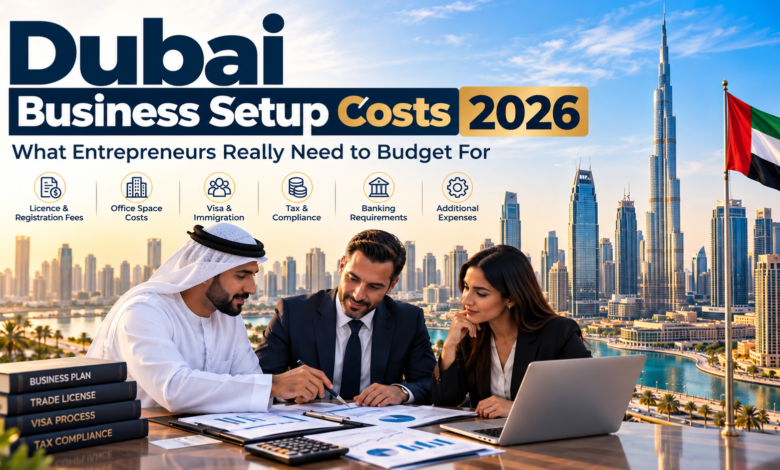
Dubai Business Setup Costs in 2026: What Entrepreneurs Really Need to Budget For

A Dubai company can sometimes be advertised for less than the cost of a mid-range laptop. That headline price, however, rarely tells an entrepreneur what the business will actually cost to launch and operate during its first year.
The true Dubai business setup cost depends on the jurisdiction, business activity, licence type, number of visas, office requirements, approvals and tax obligations. A founder running a one-person consulting business from a free zone can have a very different budget from a mainland trading company with employees, warehouse space and regulated activities.
For entrepreneurs planning a Dubai company in 2026, the useful question is therefore not simply “How much is the licence?” It is “What will the entire setup require before the business can operate properly?”
Why There Is No Single Dubai Business Setup Cost
Dubai has several company-formation routes, and each has its own pricing structure.
The two most common are:
- Dubai mainland companies licensed through the Dubai Department of Economy and Tourism
- companies established in one of Dubai’s free zones
DET currently offers commercial, professional, industrial, e-trader and dual-licence routes for mainland businesses, with setup requirements determined by the activity and structure. Its licensing platform directs investors through activity selection, trade-name reservation and final licensing rather than publishing one universal company-formation price.
Free zones work differently. Each authority sets its own licence packages, office requirements, visa allocations and registration charges.
That alone makes any article claiming that “a Dubai company costs exactly AED X” incomplete.
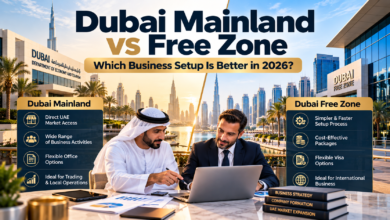
Mainland vs Free Zone: Where the Cost Difference Begins
The first major budget decision is jurisdiction.
Dubai Mainland
A mainland company is generally chosen when a business needs broader access to the UAE domestic market, local commercial premises or a structure suited to certain trading and service activities.
DET offers several licence categories, including commercial licences for trading, professional licences for services and industrial licences for manufacturing.
Mainland costs can include:
- trade-name reservation
- initial approval
- licence issuance
- legal documentation
- office or commercial premises
- Ejari or tenancy-related requirements
- immigration establishment file
- investor and employee visas
- external regulator approvals
- Chamber or activity-related charges where applicable
The final figure can therefore vary substantially even between two companies using the same legal form.
Dubai Free Zone
A free-zone setup may be more straightforward for entrepreneurs who do not require a conventional mainland office and whose activity fits the chosen zone.
But “free zone” is not a single pricing category.
For example, Meydan Free Zone currently publishes a regular licence starting from AED 12,500, with visa allocation and residency processing charged separately.
DMCC, by comparison, uses a different structure. Its current schedule separately lists charges including AED 1,035 for an application, AED 9,020 for registration and AED 2,020 for Articles of Association, alongside separate packages and workspace arrangements.
The comparison demonstrates why founders should look beyond advertisements that simply say “Dubai free-zone company from AED X.”
The Trade Licence Is Only the Starting Cost
The licence is the most visible company-formation expense, but it is not necessarily the largest.
A licence establishes the legal authority to conduct the approved activity. It does not automatically pay for residency, office space, medical examinations, Emirates ID processing, banking documentation or industry-specific approvals.
Before comparing packages, founders should ask exactly what the advertised price contains.
Useful questions include:
- Does it include company registration?
- Does it include the trade name?
- Is workspace included?
- How many activities can be added?
- Does the package include visa allocation or the actual visa?
- Is an establishment card included?
- Are immigration charges separate?
- Does it include shareholder amendments?
- What does renewal cost?
A low entry price may still be perfectly suitable for a lean business. The problem arises when it is compared directly with a more inclusive package.
Office Space Can Change the Budget Significantly
Workspace is one of the largest variables in the cost of starting a business in Dubai.
Free-zone entrepreneurs may be able to use:
- flexi desks
- shared desks
- co-working facilities
- serviced offices
- private offices
The option depends on the free zone and the number of visas or operational requirements.
Meydan, for example, states that its starting licence includes a flexi-desk, while visas are priced separately.
A mainland company may require suitable physical premises depending on its business activity and structure. A consultancy office will therefore have a different property cost from a retail unit, restaurant or warehouse.
This is one reason a simple licence comparison can be misleading. For some businesses, commercial property can cost considerably more than the licence itself.
Visa Costs Need Their Own Budget
Founders who intend to live in the UAE or employ staff need to plan beyond the company licence.
Residency can involve:
- visa allocation
- entry or status-change procedures
- medical examination
- Emirates ID
- residence processing
- immigration-related company documents
- health insurance where required
- dependent visas if applicable
Free zones sometimes separate visa allocation from the actual residency process.
Meydan’s current published pricing, for example, lists visa allocation at AED 1,850 per visa, while employment visas and investor or partner visas have separate charges.
This distinction matters when comparing “one visa included” packages. Investors should verify whether that means the right to apply for a visa or whether all processing costs are genuinely included.
Business Activity Can Increase the Cost
Not all licences require the same approvals.
A straightforward consultancy or digital-service company may require relatively few regulatory steps.
A business operating in healthcare, education, financial services, food, tourism, transportation or other regulated industries can require permissions from additional government bodies.
Those approvals may introduce:
- government fees
- inspections
- certification
- specialist premises requirements
- qualification checks
- compliance documentation
For this reason, company-formation pricing should never be separated from the intended activity.
The Dubai DET licensing system itself begins with activity and licence selection because those choices influence later requirements.
Cheap Business Setup Packages Are Not Necessarily Bad
A low-cost package is not automatically a red flag.
A founder may genuinely need nothing more than:
- one shareholder
- no UAE residency
- no employees
- a simple consulting activity
- shared workspace
- minimal regulatory approvals
In that case, paying for a premium office, multiple visas and services that will never be used makes little sense.
The important distinction is between low cost and incomplete pricing.
A good low-cost package should clearly state what is included and what will cost extra.
A poor package may advertise only the licence and disclose mandatory additional expenses after the customer has committed.
The First-Year Cost and Renewal Cost Are Different Questions
Founders often focus heavily on year one and overlook what happens twelve months later.
Renewal can involve:
- annual trade licence renewal
- office or flexi-desk renewal
- immigration establishment-card renewal
- employee or investor residency renewals when due
- insurance
- bookkeeping
- tax compliance
- audit requirements where applicable
- registered-agent or administrative services
Some promotional offers also apply only to the first year.
Before choosing a jurisdiction, entrepreneurs should request the expected year-two cost alongside the initial quotation.
A company that looks slightly more expensive in year one can sometimes be cheaper over several years if its renewal structure is clearer.
Corporate Tax Is Part of the Operating Budget
Company formation does not end when the licence is issued.
Most taxable businesses also need to consider UAE corporate tax obligations.
The Federal Tax Authority states that the general corporate tax rates for individuals and juridical persons are:
- 0% on taxable income up to and including AED 375,000
- 9% on taxable income exceeding AED 375,000
Qualifying Free Zone Persons have a separate regime under which qualifying income may be taxed at 0% and income that does not meet the qualifying-income definition may be taxed at 9%.
This is an important distinction because incorporating in a free zone does not automatically mean every dirham of profit will always be tax-free.
Companies should understand their tax position before choosing a jurisdiction solely for a perceived tax advantage.
VAT Can Also Become Relevant
VAT registration is another operating requirement that founders sometimes overlook.
The Federal Tax Authority says a UAE-resident business must register for VAT when its taxable supplies and imports exceed AED 375,000, or are expected to exceed that amount within the next 30 days.
Voluntary VAT registration is available where taxable supplies, imports or qualifying expenses exceed AED 187,500.
A growing business should therefore budget for accounting and tax compliance rather than treating these services as optional extras that can always be addressed later.
Banking Does Not Usually Have a “Company Formation Fee,” but It Has a Cost
Opening a corporate bank account is a different process from incorporating a company.
There may not always be a government banking fee comparable to a licence charge, but banking can still affect the practical cost of setup.
Banks can request information such as:
- shareholder identification
- company documents
- source of funds
- business plan
- expected turnover
- customer and supplier information
- proof of address
- contracts or invoices
- evidence of business activity
Some banks also require minimum balances or have monthly account charges depending on the product selected.
Founders should therefore avoid assuming that company registration automatically guarantees immediate banking access.
Professional preparation can make the process more organised, but approval remains a decision for the bank.
Hidden Costs Entrepreneurs Frequently Miss
Several smaller expenses can collectively change the first-year budget.
These may include:
Document Attestation
Foreign corporate shareholders or overseas documents may require notarisation, legalisation or attestation.
Translation
Official Arabic translations may be required for certain documents.
Additional Activities
Adding more activities can change licence pricing depending on the jurisdiction.
Customs Registration
Trading and importing businesses may require customs-related registration.
Bookkeeping
Even small businesses need reliable financial records for tax and management purposes.
Insurance
Health, employee or commercial insurance may apply depending on the business.
Domain, Software and Payment Processing
A company that exists legally still needs practical infrastructure to operate.
Amendment Fees
Changes to shareholders, managers, activities, names or addresses can involve additional charges.
These costs are rarely visible in the headline licence advertisement.
How Much Should an Entrepreneur Actually Budget?
There is no responsible single answer without knowing the business model.
However, entrepreneurs can build a more accurate budget by dividing costs into five categories:
1. Formation
Licence, registration, legal documents and government approvals.
2. Premises
Flexi-desk, co-working facility, office, shop or warehouse.
3. Immigration
Investor and employee visas, Emirates ID and related processing.
4. Compliance
Accounting, corporate tax, VAT and any audit or regulatory requirements.
5. Operations
Banking, insurance, software, staffing, marketing and other day-to-day requirements.
This approach is more useful than asking only for the cheapest licence available.
When Mainland Can Make More Sense
A mainland structure can be worth the additional cost when the business actually needs mainland functionality.
That may include companies requiring:
- local shops or commercial premises
- direct domestic trading
- certain government opportunities
- larger employee teams
- warehousing
- activities better suited to DET licensing
DET’s current licensing framework includes commercial, professional, industrial and other mainland licence categories tailored to different operating models.
The decision should therefore be based on how the company will make money, not which package appears cheaper in a Google advertisement.
When a Free Zone Can Be More Efficient
Free zones can work well for:
- consultants
- technology businesses
- remote-first companies
- international service providers
- holding or specialised structures
- founders requiring limited physical space
A free-zone package can reduce complexity where the entrepreneur does not need substantial mainland premises.
But the right zone still matters.
Meydan and DMCC illustrate the difference well: both operate in Dubai, but their pricing models, positioning and company requirements are not identical.
Founders should compare what each jurisdiction provides rather than treating every free zone as interchangeable.
Using a Business Setup Consultant: What Should You Expect?
Entrepreneurs can establish businesses through the relevant government or free-zone authority directly.
A consultant becomes more useful when the setup involves several moving parts, such as:
- jurisdiction comparison
- multiple shareholders
- corporate shareholders
- regulated activities
- residency planning
- external approvals
- tax registration
- accounting
- bank-account preparation
Those wanting professional assistance can compare UAE-focused business setup services in Dubai from Incorpyfy with the official options available directly from DET and individual free-zone authorities.
Incorpyfy’s current published services include Dubai company formation, accounting, VAT consultancy, PRO support and licensing assistance.
A consultant should make the process easier to understand, not make pricing less transparent. A useful quotation should separate government charges, workspace, visas and professional fees so the entrepreneur can see what is actually being paid for.
Questions to Ask Before Paying for Any Dubai Setup Package
Before transferring money, founders should ask for answers to the following:
- What exact licence is included?
- Which business activities are included?
- Is company registration included?
- Is workspace included?
- Does the price include visa allocation or full visa processing?
- Is an immigration establishment card included?
- Are medical and Emirates ID fees included?
- Are external approvals required?
- What does renewal cost?
- What are the consultant’s professional fees?
- Which charges are government fees?
- Is corporate tax registration included?
- Is bookkeeping included or separate?
- Are any deposits refundable?
A quotation that clearly answers these questions is far more useful than one built around a single attractive headline number.
What Entrepreneurs Should Really Budget For in 2026
The cheapest possible Dubai licence is not necessarily the cheapest way to build the business you actually need.
For one entrepreneur, a simple free-zone structure with no visa may be enough. Another may require a mainland licence, several employee visas, physical premises and additional regulator approvals.
The right Dubai business setup cost is therefore the cost of the structure that allows the company to operate legally and practically, not the lowest number appearing in an advertisement.
For founders planning a Dubai business in 2026, the safest approach is to define the activity first, choose the jurisdiction second and price the complete first year before committing.
That means calculating not only the licence, but also premises, residency, compliance, tax, renewal and the operational requirements that begin after the company is incorporated.
A transparent budget may look higher at the beginning. It is usually far more useful than discovering mandatory costs after the business has already been registered.

 with the direct government options available through GDRFA, ICP and the relevant company-licensing authority. Professional assistance can help coordinate paperwork, but visa eligibility should always be verified against the official immigration requirements rather than a consultant’s marketing claim. ## Common Dubai Investor Visa Mistakes ### Assuming Every Business Owner Gets a Five-Year Visa The Green Residence has specific eligibility and investment conditions. ### Confusing a Trade Licence With a Residence Permit A licence allows the company to conduct approved business activities. Residence is a separate immigration process. ### Comparing Only Government Visa Fees Medical, Emirates ID, insurance, status adjustment and professional services can change the full cost. ### Structuring Shareholding Only for Residency The ownership structure should make commercial and legal sense as well as meeting immigration requirements. ### Assuming a Free Zone Automatically Means Investor Visa Eligibility Free-zone company ownership and immigration qualification still need to satisfy the relevant rules. ### Treating the Golden Visa as the Standard Investor Visa Golden Residence has substantially higher qualifying thresholds than ordinary company ownership. ## Dubai Investor Visa Checklist for 2026 Before applying, confirm: - passport validity - company trade licence - legal form - shareholder or partnership documents - investment value - qualifying ownership percentage - current UAE immigration status - entry permit requirement - medical fitness requirement - Emirates ID process - health insurance - total government charges - family sponsorship plans - residence renewal conditions A clear checklist reduces the chance of creating a company that does not support the residence route the investor expected. ## Is a Dubai Investor Visa Worth Considering? For entrepreneurs who genuinely plan to own and operate a UAE business, a **Dubai investor visa** can provide a stable residency route without dependence on an employer. The five-year Green Residence can suit qualifying business investors and partners, while the 10-year Golden Residence provides a longer-term route for investors who meet the higher financial thresholds. The most important step is to separate three decisions: 1. what company the investor actually needs 2. how much capital will genuinely be invested 3. which residence category that structure qualifies for When those decisions are made together, company formation and immigration can support each other. When they are treated as the same thing, founders can end up with a licence that does not provide the residency they expected.](https://dubaitimes.ae/wp-content/uploads/2026/10/Dubai-Investor-Visa-Consultation-390x220.png)